A parody of Netflix, Bookflix is where you can find our books and more like them.


Edition is discontinued. Will be available at in person events until a new edition is released.
A parody of Netflix, Bookflix is where you can find our books and more like them.
Edition is discontinued. Will be available at in person events until a new edition is released.

A parody of Netflix, Bookflix is where you can find our books and more like them.


A parody of Netflix, Bookflix is where you can find our books and more like them.


Edition is discontinued. Will be available at in person events until a new edition is released.

A parody of Netflix, Bookflix is where you can find our books and more like them.


A parody of Netflix, Bookflix is where you can find our books and more like them.


Coming Soon!

Hello Readers,
In honour of this past weekend having been Can-Con I thought I’d write about writing.
I’ve been published now for just over 8 years and there’s a lot I didn’t know about the industry that I wish I did.
Everyone who writes dreams of the big publishing contracts with advances that will let you quit your job and become the next Stephen King. It isn’t that easy unfortunately (and it wasn’t for Mr. King either.) Most new authors don’t get advances or if they do they’re very small. Even older more established authors don’t get advances anymore.
Once the book is out there’s all kinds of things that have to be done and there’s the next books to think about. It’s a constant cycle.
Rarely do authors make enough money to live off and that’s fairly well known but the same can be said about everyone else involved. The majority of small presses are volunteer or owner run. The medium sized ones aren’t much better off and rely on staff that can wear multiple hats.
The same goes all the way down. Booksellers, printers, designers, typesetters, artists, and editors. All of them have multiple jobs and does it out of passion, not for lots of money. (I can’t speak about the big 5 but I’d assume like any corporation that the CEO’s and stockholders are well paid and that’s about it.)
WIth a few exceptions where a publisher has lots of faith and extra cash, they are in the business of making the best book possible, not selling your book. They will promote and some publishers do events where your book is for sale but it’s your job to push the book.
The same with any distributor, they distribute and will occasionally promote but it’s your job to sell the book.
One of the reason’s it seems that every tik-tok star is getting a publishing contract is that a lot of book selling is really selling you. (Not ideal for a curmudgeonly introvert like myself.)
Books have a shelf life or life cycle. They are born and they hopefully sell and then eventually they die. Big named books being an exception as usual. Most publishing contracts have a 5 to 10 year clause that says if your book doesn’t sell the rights return to you. (If your contract doesn’t say you get the rights back after your book is out of print, insist they change it.)
Series have longer lives because the first few get a boost with every new release.
If you are self publishing, you’re paying for everything. If you get a publisher they pay for as much as they can. With a publisher the money should go toward the author.
That’s mostly true, but it’s not always true. Sometimes you need to pay an editor to make sure your book is good enough for submission. Sometimes you need to pay for graphic design work for promotion, and if you’re going to sell your book solo at events, that’s your responsibility.
But just because you aren’t paying for things doesn’t mean they don’t cost the publisher which is why they can’t throw around advertising money like the Big 5.
*Warning* There are a lot of companies out there promising to make your book a best seller. They promise to do everything for a large sum of money. Best case scenario you don’t make your money back. Worst you lose the merchandising, film, and even the copyright to your own books. Writer Beware is an excellent source if you’re approached by these predatory companies.
Thank you for reading and check out some of my books!
Éric
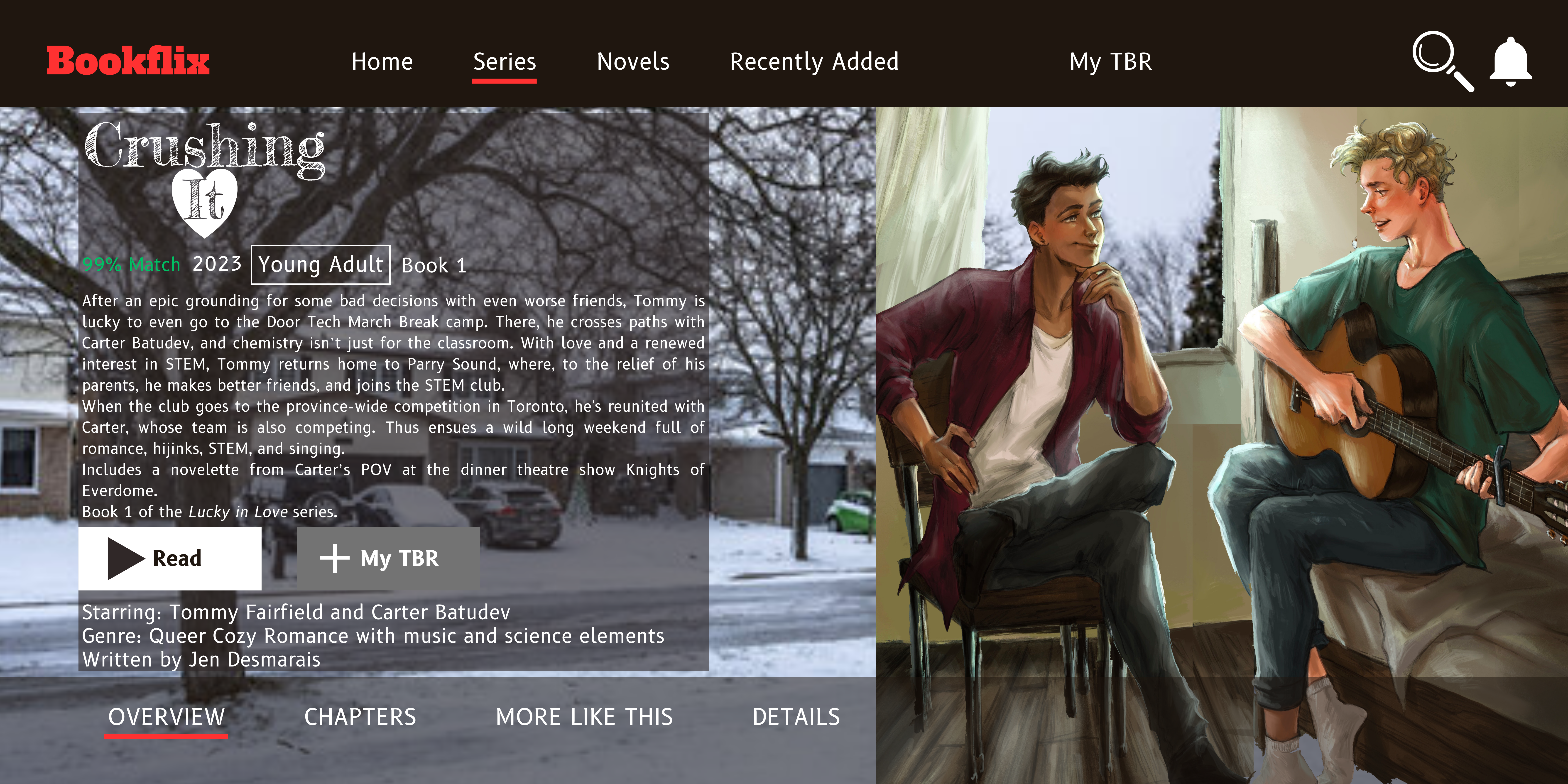
A parody of Netflix, Bookflix is where you can find our books and more like them.


Crushing It by Jen Desmarais is available now!
Physical from Canadian indie bookstores, physical from Indigo, electronic version
Hello Friends, Family, and Fans,
On Friday, Jen explained how she plots her novels. Now it’s my turn. This is the way I do it mostly. Sometimes I just jump right in, and when I’m writing with Jen we blend our methods.
This is the most exciting step. I get a thought about a character, story, scene, villain, mood, or concept, and then I let my mind wander. Sometimes it takes years before I move past this point.
This is the stage were I get excited and talk to Jen about it. If she gets excited, that’s great, if not then I need to think some more.
This can take the form of a Proof of Concept (a short story or first 1000 words of a novel), a blurb, or if I’m really excited, an outline.
Before I start writing my outline, I start with my numerical goals. I need to decide if I want shorter or longer chapters, length of the book, 3 act structure or 5 act structure like Freytag’s pyramid, possible sequels, first or third person, and how many points of view.
Next, if I’m doing it right, I start making information tables for each of the main characters (I’ll be honest I sometimes do this later during writing. Every time I forget to do it I regret it.) I also like to build the same information for towns or locations.
At this point, I write a list of everything that should happen in each part of the book and throw as much as I can at the page. Then I try to make a list of all the chapters, with who the POV is and place the events I have in the chapters.
I spend a lot of time on the story beats based off the act structure I chose. (I really like using elements from the Hero’s Journey.) Sometimes these are as simple as “needs scar” or “action scene”
This leaves a lot more holes than you’d think. I try my best to fill in as much about the first act as I can.
I also put in an ending for the book.
No plan runs perfectly smoothly. As I write, I discover what I like about the story and what I don’t, and I need to adjust. I also get ideas for future scenes or plot points and add them to the outline.
In The Mystery of the Dancing Lights, my original outline was completely different, and I realized I wasn’t feeling the plot, so I wrote in the time loop and had to stop writing to adjust the entire outline.
I think about the book and daydream about it non-stop and as I do that, I get ideas and plot points. I add those to the outline.
When I notice themes or have a definite ending, I start adding foreshadowings and more thematic elements into the outline (sometimes I have to go back to add them).
This is the ideal and every book I’ve written has had modifications. I try to follow the rule of “follow your instincts” as much as possible. Just because the outline says something doesn’t mean I’ll do it if I feel it’s not right.
I also spend a lot of time talking to Jen about the book and getting her feedback. If she gets the forehead scrunch or starts to twirl her hair and staring off at a distance, I know it’s not working for her.
Stay safe and be kind,
Éric
Step 1: Panic!
Step 2: Write 3 sentences that cover the main 3 beats of the story; beginning, middle, end.
Step 2a: (Because I forgot about this one and don’t want to renumber) Write out the character info for the main characters and secondary characters. The main characters should include descriptions of themselves as well as their motivations, weaknesses, strengths, nicknames, etc. Anything I can think of to make them who they are. Secondary characters only need descriptions at this point.
Step 3: Write out everything I can think of in jot note form for each beat.
Step 4: Ignore all of that and start a new document.
Step 5: Break the novel into the 3 parts. Decide how many chapters I want in each, and how many words will be in each chapter. (I usually say 3k as an approximate, 8 chapters in each part.)
Step 6: Copy all the jot notes into their appropriate chapter.
Step 7: Make sure everything flows properly. Fill in any missing information. Add red herrings and foreshadowing at appropriate points.
Optional
Step 8: Count the high action scenes (fight, sex, whatever) and make sure they’re spread out decently.
Not listed: Ask Éric for help at every step above so he can reassure me that I do, in fact, know what I’m doing.