I’ve been thinking about something off and on for the past few weeks: stretch marks, and why mine don’t really bother me.
When I was 8 years old, I grew four inches in a year. Then it happened again when I was 9. I had stretch marks on my thighs from that point forward. They’ve faded over time and just look like little white squiggles now, but they bothered me a lot when I was a teenager.
I didn’t grow very much at the beginning of my pregnancy, but by mid-summer I had some tiny stretch marks under my belly button. Then in the last few weeks I grew a lot more, and quickly, so I got a few more. They were quite dark. They’re a little paler now, but still very much present.
I went swimming with Dragon last week, and I realized I didn’t really care about them, for several reasons. For one, superficially, I know that Eric loves me no matter what I look like, and I don’t need to attract anyone else. Two, whenever I look at them, I see what I went through to have my daughter. I never understood the sentiment behind the “tiger stripes” movement, but I get it now.
And three, I understand where stretch marks come from, and why I have them. It makes such a difference to understand why your body does something, I find.
Reasons for Stretch Marks
Fast changes in the body (growing or shrinking)
Genetic tendency
Cortisone level in the body
You can be any gender, any size, or any age, and you could get stretch marks. They appear when the body undergoes a big change very quickly. If cortisone levels are high, the elasticity of the skin is compromised and stretch marks are more likely to occur.
People likely to get Stretch Marks
Bodybuilders
Pregnant people
Teenagers
Adults
You get the idea…
I hope this helps you to feel better about your own stretch marks.
Here are some home remedies to help treat stretch marks. Just in case you find it helpful.
Thank you to the contributors to all the guest posts for Blush and Fandom Travel! If anyone else is interesting in writing for either of these topics (and it can easily be kept anonymous!) please send me an email to jenericdesigns@gmail.com and we can discuss which topic you’d like to write about.
This week’s guest post is written anonymously. Please respect their privacy by not trying to guess who they are.
Being Polyamorous isn’t about sex; I think that’s a preconceived notion many people have about it; it’s about having a relationship. More specifically it’s that I have multiple relationships, some of varying degrees, but they’re all relationships with some kind of emotional connection. I think a lot of people assume that being poly is the same as having an open relationship, or being a swinger; that at the end of the day it’s just about having multiple sexual partners, it’s about “free love” and the likes; and while we are free to love, it’s not about all the things that 60’s anti-hippy propaganda films think. Our relationships can vary from being very good friends to marriage.
I personally learned about poly the old fashioned way, word of mouth. My partner and I made new friends, who led us to more friends, and through them we learned about it, and just how common it actually was, finding almost a network of different poly relationships, and that we were far more connected to it than we realized. We spoke about it and realized that it was something that caught our interest; we’d been together for a long time, and felt we were ready to take the plunge.
I can’t say that we have any specific labels for our version of poly, my first partner (the one I’m married to) is someone I generally refer to as my primary, but otherwise it’s pretty simple. Other people I’m with are partners, but not referring to them as my primary doesn’t mean I care about them any less. We get asked how it works fairly often, the answer is the same as for any relationship: communication, honesty, and time. Talk with each other, if something’s bothering you, let your partner(s) know. Be truthful, lying doesn’t help anyone, especially when more than two people are involved, and make sure you have time for everyone; if you can’t give someone the time they deserve, you might need to reassess and make time for them. Poly isn’t easy, but no relationship is. Give it the time and thought, and anyone can make it work.
There are some things that I’ve only recently realized were weird during my pregnancy, like that hair grows abnormally fast. Armpit and leg hair included. Or maybe it just grows slower now that I’m nursing.
Contractions don’t necessarily hurt very much at the beginning. It took mine about 7 hours to start being anywhere near the realm of what I would call painful.
Then there’s all the weird delivery stuff that happens:
You will get used to, or not care, that you are naked in front of people
Labour might be way longer than you expect
You will probably throw up during the pushing part of your delivery because of how hard you’re pushing (I did)
You will probably poop at some point during delivery (I didn’t)
The placenta is bigger than you think, and very squishy-hard when it comes out
The first time you get up from the toilet (whatever you excrete) will be terrifying – there is SO MUCH blood in the toilet. Don’t worry – the next time will have a lot less
You still look pregnant after delivery – it’ll take some time for the belly to go away. This makes for a great resting place for the baby if you choose to nurse
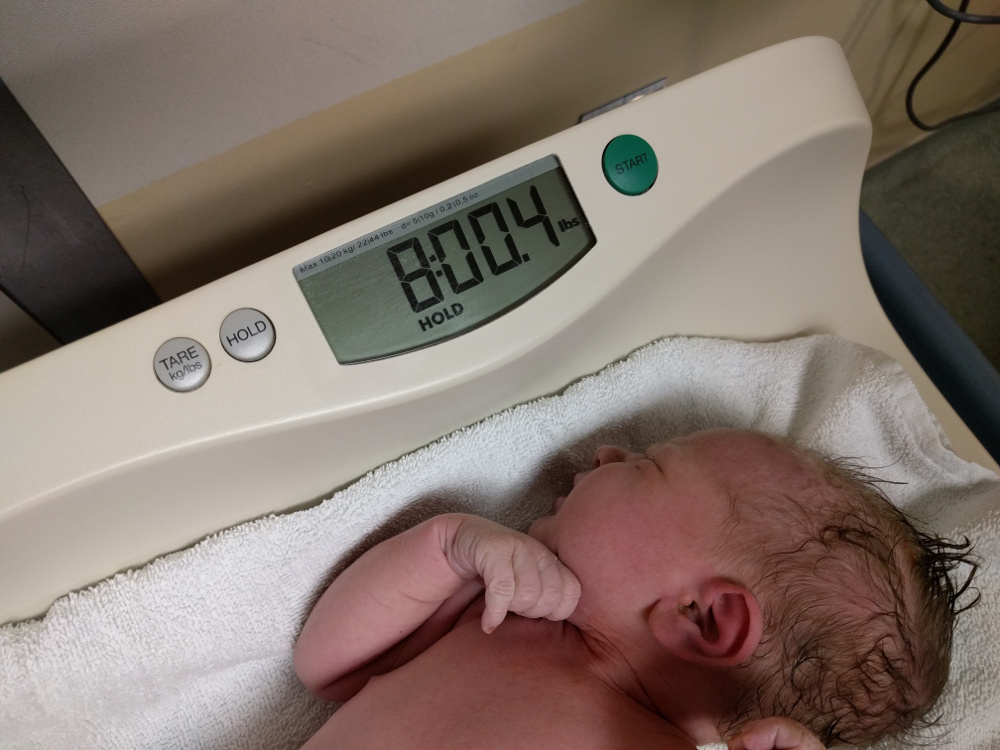
Photo credit to Kat, who managed to sneak in just before noon to meet Dragon.
There’s also some pretty strange things that nobody tells you about having a newborn, like cluster feeding – this is what helps the milk to come in, and it happens over the second day and night. It’s exhausting, and would definitely have made us think we were doing something wrong, because she woke up every hour to feed a tiny bit and then go back to sleep. Every time the baby has a growth spurt, this happens again, except on a slightly smaller scale.
My first novel A Study in Aether, and Jen’s game Blush will be launched this Saturday the 29th of October at a Monster Launch (We’re launching books not monsters, but feel free to come dressed as a monster.)
Come by and say hello and get a signed copy and meet lots of amazing Authors.
The celebration will be held at the 3 Brewers pub (240 Sparks St., Ottawa)
Saturday October 29th, 2015, from 5:00 – 7:00 PM.
There will be readings by the authors, prizes to win, special prices and of course, the opportunity to get your books signed. The authors will be wearing costumes, so please feel free to dress up as well!
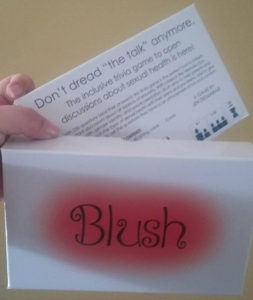
With 250 questions (and their answers!) this trivia game is the perfect tool to initiate important discussions about all aspects of sexuality. With subjects like reproduction, general health, gender identity, and sexual orientation, Blush aims to help parents and teachers approach the topic of sexual health with their teens and pre-teens, and to give kids the opportunity to ask the questions they have in an atmosphere of fun and comfort.
A supernatural suspense which follows Adam Godwinson, the main character of The King in Darkness, as he tries to save the children in a small northern Québec town.
This science-fiction comedy follows the adventures of Virj Ofreesin, a lovesick writer who goes on a foolish adventure to save the half of the bigender being he loves… in all the wrong places.
A spy thriller which delves into the dark spaces we have within our own souls, all the while taking us on a thrilling adventure which follows an unusual girl trying to solve the murder of the only person she ever really cared for.
An undead woman, a scared boy who can manipulate machines, a nefarious laboratory trying to find the secret to eternal life… and did we mention zombies?
Chased by wraiths of dark smoke, without knowledge of the land in which I found myself or memory of my life and purpose, I became embroiled in a perilous quest to restore the throne of a fading Empire. Little did I know how dangerous a task that would prove to be.
This is my story; the tale of the Sky Road Walker.
Sky Road Walker is the first of the democratically created Your Very Own Adventure books by author S.M. Carrière.
Proceeds from the sale of this book will go to The Ottawa Caring and Sharing Exchange, a charity which provides relief and dignity during difficult times of the year.
A Sherlock-Holmes-obsessed girl detective, a bunch of disappearances, a witch, and… mittens? Dive into this highly entertaining Young Adult paranormal mystery set in a small Ontario town!
Wolf ice disinhibits werewolf brains: it makes them act like animals. Lusty, angry, hungry animals. Wolf ice drives Leila straight into the arms (and on to other anatomical parts) of her ex-boyfriend.Wolf ice could slay all Montreal wers–in fact, all wers around the world–unless Leila stops him. Will she fight past the lust in order to save her species?
ISBN 978-1927341520 – Available now!
For more information, please contact Renaissance Press:
Cait Gordon is the author of Life in the ‘Cosm, a comedy sci-fi with love, adventure, and an unusual amount of dessert. You can find her on her website, Facebook, and Twitter, and can meet her at the Massive Mega Multi Author Launch on October 29, 2016. Both her book Life in the ‘Cosm and Blush will be officially launched on that day, so come out (in costume if you wish!) and enjoy the party!
A shout-out to Jen Desmarais for asking me to contribute as a guest blogger. Thank you so much for including me in the discussion. It’s really important for non-disabled folks to remember that people with disabilities can and want to get it on, too. (Cue the slow jam of choice.)
Drawing by Cait Gordon.
I have a disability that causes widespread nerve pain, chronic fatigue, and mobility impairment. My turn-ons include fresh sheets, kisses during walks in the sunset, and cupcakes. Like a shocking amount of people I enjoy having sex, and I don’t mind saying so. Does that make you feel uncomfortable? Well, according to an article I read on the Disabled World website: “Sex and disability tends to be a taboo area for many abled bodied persons and is rarely discussed in the same sentence. As a result more than 50% of disabled people do not have any form of a regular sex life.” (Disability Sexuality: Information on Sex & Disabled Sexual Issues, Disabled Word)
I reckon that just because half of people with disabilities aren’t having sex, it doesn’t necessarily mean it’s their preferred choice. They are mostly-likely the victims of incorrect assumptions and ignorance.
At Can*Con 2016, I attended a candid panel about sex led by Canadian author Angela S. Stone. In my opinion the panellists created a safe space for us not only to talk about how we can write about sex as authors, but also to discuss how we have sex in real life. When Angela spoke about there being ways other than the missionary position, I agreed wholeheartedly. My hand shot up and I said, “I have a disability. That’s why my husband and I created the Gordon Sutra.” I meant no disrespect to the actual Kama Sutra, but it was my way of describing how as a married couple, we figured out there was more than one way to do the magical it. I also added, addressing the other authors, “Please make sure to write about disabled people having sex, because we have sex, too!” We really do, you know.
Several years ago a young person in my life, who understood how acute my chronic pain was, asked me, “So, sex. Do you still have it?” I replied, “Yup, it’s my anti-inflammatory medicine!” For me—and I am talking about my personal experience only—having sex increased my circulation and loosened my overly-stiff connective tissues. The endorphins reduced my awareness of pain, and the orgasm relaxed me all over. This special connection with my spouse did many things I cannot even explain scientifically. It was a natural therapy while remaining a delicious way of expressing love with my partner.
Things went merrily along with my sex life until I developed chronic severe nerve pain in my pelvis. It lasted four years and was so acute, it even hurt to sit down on a firm chair. Intercourse was mind-numbingly painful. Eventually, everything came to a full-stop in the bedroom. Gone were the lovely anti-inflammatory benefits, replaced with the fear of having sex. I sought medical help for years, without finding a solution. In fact, my pain became much worse and debilitating. Even though my spouse remained remarkably understanding and extremely affectionate, I missed being with him in that way.
Finally, a gynecologist who I’ll name Doctor Awesomesauce explained that my nerve pain was preventing her from examining me. She said it was the equivalent to being poked in the eye. Yowch! Doctor Awesomesauce diagnosed me with pelvic myalgia, which had been triggered by extremely weakened pelvic floor muscles. The prognosis showed I had a good chance that pelvic-floor physiotherapy would work for me. I tried it. Even after the first two weeks, I noticed some pain reduction. I couldn’t wait to have sex again!
It was still difficult to do right away, though. Then it hit me—the heck with intercourse for now. Let’s try outercourse!
Why do we underplay sexual touching? Or am I the only one who thinks we do? I nickname it, “Going to the Petting Zoo.” It’s so sexy all by itself and I wish I had thought of it earlier. Happy sighs were emitted and regular love-making was back in our lives again. After several more sessions the pelvic-floor physiotherapy was successful and now I have a whole arsenal of options to choose from whenever we bring sexy back in our homestead.
You see, lovely non-disabled peeps, I never once thought for even a fleeting moment to accept my disability as a reason for not having sex. As with everything in my life, I just try to find a workaround that makes sense for my body. My libido is quite healthy, so I have the desire to nurture it like anyone else does, and often. Woof!
To readers with disabilities, I salute you, and hope you find the best solution that works for you, medical help with listening ears, and a partner who is enthusiastic to help you in your quest. I even wish you a method that does the job you when you’re all by yourself! It can sometimes be a bit of a maze to discover the how-to’s, but it’s well worth the journey.
At Can-Con over the weekend of September 9-11, 2016, we had the opportunity to meet some incredible people. Jen Desmarais (website) is…well, me. (This is incredibly weird to write.) I am a card game designer for the sexual education/communication game Blush, published by Renaissance Press (Twitter, website)! You can meet me at the Mega-Multi-Author Launch happening Oct 29, 2016.
For the next few weeks, both Blush posts and Fandom Travel posts will be guest posts. Thank you to the contributors! If anyone else is interesting in writing for either of these topics (and it can easily be kept anonymous!) please send me an email to jenericdesigns@gmail.com and we can discuss which topic you’d like to write about.
This week’s guest post is written anonymously by kitten. Please respect their privacy by not trying to guess who they are.
Example of a BDSM day collar. Item designed by TheCagedFlower on Etsy.
I guess preconceived notions about what someone would look like when they live a certain lifestyle come with everything: you expect a high powered executive to always be dressed in a suit with shiny shoes, a plumber to have pants that can’t stay up and someone in the BDSM lifestyle to look edgy with lots of tattoos and always in leather with a very obvious collar on their neck. I’m probably the furthest from what you’d expect, and aside from the black ribbon around my neck and the ring that says “collared” as well as my Dom’s fingerprint engraved into it, you’d probably never know that my Dom and I are in the scene.
I didn’t intend to become a part of this lifestyle. I actually remember very well when it piqued my interest: I was sitting in a summer course, chatting with a male friend of mine while another student was doing a presentation (yes, I know I should have been paying attention, but I still got a great mark in that class). My male friend started to tell me about some of the exploits he and his girlfriend had been trying out. The more he told me, the more questions I had for him, and the more curious I was about it. I did what any good student did: I researched. I found blogs and books and devoured them all. The more I read, the more I felt like something clicked inside: this fits me.
But all of the research and reading in the world couldn’t give me the experience that would prove that I wasn’t just enthralled by the idea of it all. I needed to try it out with a partner. I brought up the idea to my then fiance, and while he tried once to give me what I was asking for, it always felt like he was just playing a part. I needed to be with someone that was inherently Dominant. Someone that had the knowledge, the intuition, that it was as much of a part of them as their eye colour is. It wasn’t until I separated from my ex-husband that I was finally able to get that experience.
I didn’t choose the best person for that first experience; I chose the most convenient person. Considering they are very well known in the area, I’ll keep the details to myself other than saying be very, very careful about choosing a play partner. There are a number of people masquerading as “Dominants” who are just emotional manipulators. Listen to your instincts and talk to other people that know them. Get references. (Sounds extreme, but if you’re into extreme play, it is very important.)
All that said, I’m happy to have discovered that this is part of my sexuality. My current partner and I are in a 24/7 relationship, though we don’t always have kinky sex. If asked, I will tell you, though I don’t shout my sexual tendencies from the rooftops. My belief is that what happens in my bedroom is my business between my partner and myself and that I do not need anyone else’s opinions or judgements there.
As much as sexuality and gender identity can run across the spectrum, so can the degrees of what people consider to be “kinky” sex. Our version of kink includes bondage, pain play like hair pulling or biting, and impact play like spanking (either hand or with an implement like a crop or a whip), and exhibitionism. These kind of scenes take a while to set up and get ready, which doesn’t always make them feasible when we both work long days. It’s easier when we go to a BDSM club in town (yes, Ottawa has them; don’t look so shocked) because they have the set up for crosses, ceiling hooks for suspensions, tables, etc all set up.
When we do play, we use a pretty easy set of safe words: green, yellow, and red. They work just as you think they would; green is good to go, yellow is slow down and give me a bit of a break, red is STOP. We decided that these work best for us because it is what Dungeon Masters (safety/security monitors that makes sure everyone plays safely) in clubs ask for. It just made sense so we wouldn’t have to try and adjust our usual play for a night out.
Never, NEVER play with someone that won’t let you use safe words unless you have talked about it extensively beforehand. Part of the appeal of BDSM is that element of danger in a safe space, much like riding a motorcycle. But you or your partner could be seriously hurt (physically, mentally, and/or emotionally) if you don’t use a safe word and continually check in. I know some people have been with their partners for so long that they don’t use safe words any longer, and that some Dom/mes (typically, Dom means males and Dommes means females, but there are any number of titles for both, as well as for non-binary Dominants) won’t let their submissives use them; those are not people that I would ever consider playing with and I’d suggest the same for anyone new to the scene.
There are some BDSM elements that are a part of my daily life: my Dom gets a picture of my outfit every day to approve before I leave the house, I always have to wear my day collar when I’m out and away from him, and he always needs to know where I am, who I am with, and when to expect me home. I have different rules when we are out in scene: I don’t talk to anyone without his approval first, I don’t make eye contact with other Dom/mes, I wear my play collar and my leash is attached to him unless one of us is going to the bathroom. If it’s me, he waits outside the bathroom for me, if it’s him, he will give me leash to either a Dom he trusts or a Dungeon Master in a club. Some days I act like a bit of a brat and push back and argue with him about my rules; that usually results in a punishment spanking for me. That said, when I am truly upset or aggravated about one of my rules, he is ALWAYS willing to discuss it. Having the door open for communication is of primary importance for us both.
I imagine that my sexuality and turn ons will always evolve and change, and I’m open to that. Being aware of who I am, of what I want and need, took me a long time to accomplish, so I wear my Day Collar with pride. As Dolly Parton said, “Find out who you are and do it on purpose.”
Jen has graciously offered to be a conduit for any questions that may pop up, and I’m happy to answer the best I can. If I feel like it is out of my realm of knowledge, I’ll try to help you find a good resource.
That’s my view; have fun, and play safely.
– kitten
A good resource for people with questions would be FetLife. You will be required to sign up to access it.
Another great resource is A Submissive’s Initiative. There are tons of resources to be found through this page as well.
For the next few weeks, both Blush posts and Fandom Travel posts will be guest posts. Thank you to the contributors! If anyone else is interesting in writing for either of these topics (and it can easily be kept anonymous!) please send me an email to jenericdesigns@gmail.com and we can discuss which topic you’d like to write about.
This week’s Blush guest post is written by Nathan Frechette, and you can follow him on Facebook here. Nathan is originally from Montreal, but has been living in the Ottawa/Gatineau region since 2004. He is a sequential artist and author. He has published several short stories, both sequential and traditional, as well as two graphic novels and six books. He was the editor and director for the French Canadian literary magazine Histoires à boire debout, and works at the Ottawa Public Library. He now is the editor and director for Renaissance Press. He has been teaching creative writing since 2005, and GMing various table-top RPGs for the past 19 years.
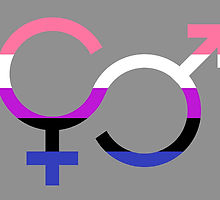
Genderfluid symbol courtesy of Reidtastic on redbubble.
I’ve always known I was different. Not just a little different, but completely apart from others, something else entirely. When I was a child, I used to think I must be an alien. Another species. Because there was no one like me.
Sure, I wore my hair short, I wore trunks to swim, and I sometimes pretended to be a boy when I was with kids I just met. I identified with men as the heroes of my stories. Often, I wished with all my heart that I was a boy.
Except I didn’t not want to be a girl. Not all the time, anyway.
Some of the days, I hated the body I was born into. Pudgy, awkward, too tall and too short at the same time, and female. Especially female. But sometimes, very few times, but still sometimes, I did enjoy being a woman. I tried growing my hair long and braided it in fancy ways, and I hated it as often as I loved it but most of the time it was OK.
I’m thankful there was such a thing as tabletop role-playing games. They allowed me something I never had the courage to do in real life: go by a male name, be referred to as “he”, and all in the comfortable illusion of fantasy, which was just pretend and could be over at any time, and didn’t commit me to any revelation about myself. The happiness of being able to explore the male aspect of my personality, which is the dominating side, made me quickly addicted to these games. I started playing them with my cousins when I was only twelve, and by the age of 17, I was spending all my time – and I mean, all of it, outside of work and school, I spent 2 hours sleeping every night and every other waking moment I was doing this – on a chat software called MIRC, role-playing with a group of people from all over the world, as several characters (all male, of course). Sure, I got teased a lot for playing almost only male characters, but that didn’t matter to me (beyond reinforcing the idea that I could never tell anyone what was going through my head, of course).
I got a little bit more daring with chat groups; even during the times where we were, as we call it, OOC, or Out Of Character, I still pretended I was a boy – because doing it as a character in a fantasy game wasn’t enough anymore. I quickly got outed as “a girl” and I had a really hard time explaining to my friends why it was important to me that they see me as male, at least some of the time. In fact, I had a hard time explaining to anyone – even people in the queer support groups I visited as a teen – what was going on in my head, what I was going through with my gender identity. Non-binary identities weren’t that well-known in the early 90s, back when very few people even knew about the internet, let alone used it.
It was in high school that I first learned what transgender was and I kind of felt like it applied to me, because I did want to be a boy, but hesitated to use it to label myself, because I didn’t want to stop being a girl. Thinking about it, exploring it, I realized that I didn’t think I’d ever want surgery, because I wasn’t ready to lose my body, no matter how I felt about it. So even that didn’t fit me. I felt even more alone, because I thought I’d found something that defined who I was but it didn’t, really. Because I’d never fully transition. That much was always clear to me: I’d always have one foot left in womanhood. Being pregnant and having children made me even surer of this than I was before: no matter how triggering my period got, being a woman was wonderful at times.
My first inkling of my true gender identity came through a book, a science-fiction novel, actually (which seems very fitting, after thinking I must be a secret alien for so long). It was Ursula K. Le Guin’s The Left Hand of Darkness, a novel about a planet on which the inhabitants are not male or female, but rather exist as both and neither, in a state of neutrality most of the time except for a few days a month when they become fertile, and gain the physical attributes which most people associate with male or female, so they can reproduce. Not everyone gets the same sex every time; it can vary depending on the month, so that most people who have children are father to some, mother to others.
That book was a revelation. The concept of being one gender AND the other, depending on the day, was exactly what I had felt my whole life but couldn’t put words on. I still wasn’t able to put a word on it, and the irony that the characters were aliens was not lost on me, but still, it made me feel a little better, like there was someone else in the world that was thinking these things, since she was writing about them. I still felt like a freak, not one thing and not the other, but there was at least one other person in the world who had had these ideas.
I put it aside at the back of my head, and tried to move on with my life. I started writing more seriously, and as I started to examine what I was writing, I came to realize that most of my characters were male, so much so that some of my stories didn’t even pass the low bar of the Bechdel test. As a feminist, this bothered me a great deal, and I tried writing in more women, but I never felt as whole as I did when I wrote about male characters. They permitted me to express my stifled masculinity, to live through them the identity I wanted for myself.
It wasn’t until a good decade after that, when I started a relationship with my wife, that the last of the pieces of the puzzle that was my gender identity fell into place. Since she was a transgender woman just coming to terms with her identity and starting to transition, I started doing some research, and getting involved in online communities so I could support her to the best of my abilities. And this is how I found out about non-binary gender identities, and most important of all, the term “genderfluid.”
There are no words to describe the feeling of finding a word that fits exactly who you are, how you feel. At long last, you aren’t just a lonely freak, an alien, different from everyone else in the world; there are others like you, lots of others, enough of them that there is a widely-used word to define it. It’s suddenly belonging, finding your people, being understood. It’s your entire existence being validated; it’s such an emotional rush that defies description. There are those who sustain that “all these labels are divisive” or that they are “unnecessary”; but really, labels can be life-saving. They have the ability to unite you, make you feel part of a community; to make you feel like what you are going through is not only normal to some degree, but also that you are not alone.
I still write about men. Gay men, actually, a lot of the time, because this allows me to express my queerness (I’m also pansexual, which is a whole other thing to explain) as well as my masculinity, and I’m getting more and more comfortable with that; it’s a healthy way of exploring my masculine side in the safety of my own head, and it makes me feel balanced.
I will be at Can-Con this weekend, barring delivery obviously, and you can buy your copy of Blush there for the first time ever!! I am ridiculously excited to hold it in my hands!
I have been reticent to talk about the concept of virginity for many reasons, the dominant one being because of how much of it comes down to opinion. I try very hard to keep my opinions out of these Q&A Blush posts, and it’s never easy.
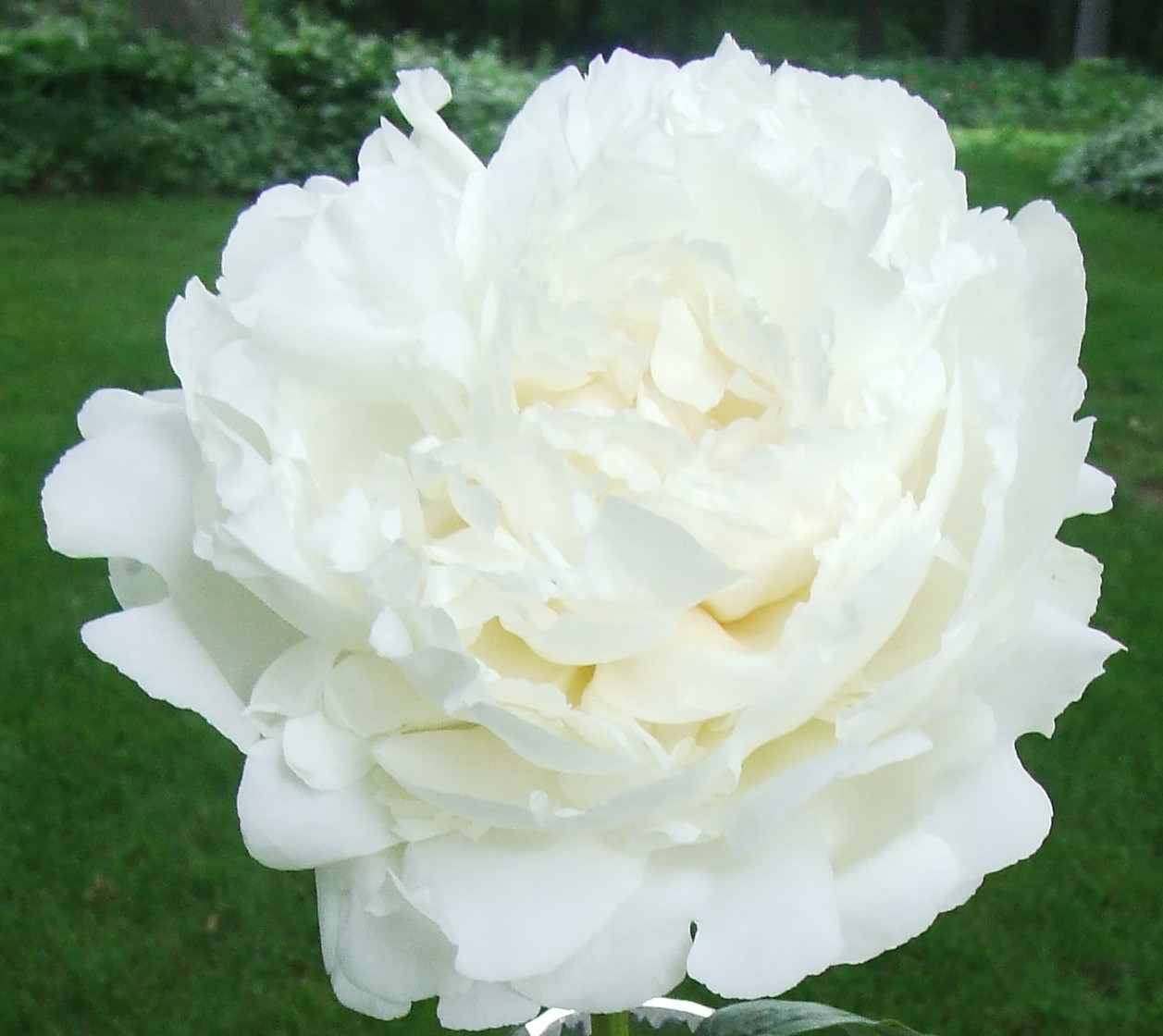
A pure white flower is often the depiction of virginity. I chose a peony because it’s one of my favourite flowers, and it’s symbolic in a way – ants have to eat away the exterior waxy coat before the flower can bloom. Image from www.bridgewatergardens.com
Question
Where did the concept of virginity come from?
Answer
Originally, the term came from Greek goddesses Artemis and Hestia. They were unmarried goddesses, and labelled as “virgin” because they were strong and independent women, and capable of resisting the temptations of Dionysus – the god of seduction and wine. Virgin was a word of power.
Unfortunately, in the medieval ages, the term was turned into what we automatically assume today – a virgin as a heterosexual person with a vagina who has not had sexual intercourse with a person with a penis. Tests of chastity were performed, which looked for such things as an unbroken hymen. Please read my post about hymens from last September here. Not only are some people born without a hymen, but they degrade over time.
Something to consider, for the medieval ages – they married at a much younger age than by today’s standards, so it is possible that the hymen had not degraded fully at the time of marriage. But can you imagine if such a test were performed now?
The common definition today is someone who has not been penetrated or penetrated another sexually. It is important to remember that virginity is a social construct and has no physical or biological effects or definition.
Question
How does one lose one’s virginity?
Answer
Let me repeat that virginity is a social construct, and therefore not a stable fact. The way to lose your virginity depends on your definition of virginity.
At the risk of being pedantic, the better question is “Why does it matter if you’ve had sex?” This is a question you need to decide for yourself (or with the help of a medical professional, therapist, or religious leader).
Again, there is no physical, chemical, or biological basis or effect from having penetrative sex.
Important
Whether you and your partner are “virgins” or not, it is extremely important that you are tested for STIs (there are many ways to contract STIs that do not involve sex) and it’s important you use protection.
Before I get started on the post, I’d like to share a piece of good news I got yesterday from my publisher. The Blush cards have been completed, and the printer has shipped them! They should be arriving at the publisher’s on Monday! I am ridiculously excited about this, as it is earlier than anticipated. Whee!!
Fu Yuanhui is a Chinese swimmer in the Rio Olypmics. Image from www.shockmansion.com
This Chinese swimmer got her period during the Olympics. The day before her race. And apparently she gets debilitating cramps while on her period. Ouch. As someone who (usually) bleeds every month, it surprised me that it hadn’t occurred to me before this point what athletes did about the cramping that (might) come with their periods while during a meet.
Apparently it hadn’t occurred to me because it’s a taboo to discuss it in the sports world. Really? Ok then. Not my place at all to judge. But it certainly surprised me to hear that. But what surprised me even more was what was said as I continued to read the article; only 2% of Chinese people who get their periods use tampons. (In the US, 42% of menstruating people use tampons, for comparisons sake.)
I am a swimmer. Not competitively, but I was a lifeguard. I taught swimming lessons. I love the water. I used tampons from age 14-23. Not always successfully… but that’s a story for another time. Now (when needed) I use a menstrual cup called a Diva Cup.
So to hear that only 2%, TWO PER CENT, use tampons… it boggles my mind. How do they swim? Or do they just forgo swimming one week every month?
Not only do they not use tampons, but a lot of people aren’t even aware that they exist. Or weren’t, until Fu Yuanhui talked about swimming on her period on national television. Apparently someone even accused her of lying about being on her period, because how could she swim?
Hopefully this opens up a healthy discussion about menstruation and the variety of products available, and more menstruating people can have the opportunities that were so long denied to them.
P.S. If you go and read the article, there is more content, including whether menstruation affects sports performance, and whether using a tampon stops the person from being a virgin. The former would be an incredibly long post involving a lot of research that has yet to be done conclusively, and the latter is another post entirely – about what virginity means. I’ve been avoiding talking about this subject because I’m afraid of including too much of my opinions, but I think it’s time for that discussion…in two weeks.
P.P.S. If you are interested in doing a guest post about a topic that would fall under Blush, please let me know! This can be done with credit given, or anonymously. Please contact us at jenericdesigns@gmail.com